The Youngbloods - Beautiful! Live In San Francisco (1971 us, amazing west coast psych, Sundazed edition)


Recorded live at Pacific High Recorders in December 1971 for radio broadcast on KSAN in San Francisco, this is a fine-sounding document of the Youngbloods playing live shortly before their breakup. It does catch them a little past their prime -- most of the songs are from their later career, not their better, first half -- and the energy's a little lower than it was during their best folk-rocking days in the late '60s. There's also a greater tilt toward rootsy country and blues sounds than there is toward the folk-rock-pop that distinguished some of their finest earliest work. 

Still, the band does play well here, and Jesse Colin Young's distinctive tenor voice and Banana Levinger's equally distinctive jazzy electric piano are both in fine shape. There's also the bonus of a few songs that didn't make it onto the Youngbloods' albums, including a cover of Dave Dudley's country trucking classic "Six Days on the Road," the folk song "Old Dan Tucker," and the Young original "Country Home," which he'd record on an early solo album. The highlights are still the original pieces in which they combine folk-rock and laid-back jazzy psychedelia, including the hit "Get Together," a version of which closes the set. 
by  Richie Unterberger

By the time the Youngbloods, always crowd faves at the west coast ballrooms, performed live for San Francisco’s free-form radio pioneer KSAN in 1971, they’d honed their set to a fine gloss. Featuring the smooth as apple-butter voice of Jesse Colin Young and the guitar/keyboard wizardry of Banana, backed by the rock-solid bass-and-drum tandem of Michael Kane and Joe Bauer, the Youngbloods positively sparkle here. We’re elated to present a lengthy, previously unissued 13-song set that’s equal parts rocking R&B, dreamy jazzers and honky tonk flag-wavers, with just a little bit of psychedelic weirdness—topped off, of course, by a knockout version of their generational anthem, “Get Together.” The Youngbloods: at the top of their game, making it all look so easy—and so damn beautiful. - See more at: 


Tracks
1. Six Days on the Road (Earl Green, Carl Montgomery) - 3:45
2. Country Home (Jesse Colin Young) - 3:56
3. On Sir Francis Drake (Lowell Levinger) - 2:46
4. Dreamboat (Jesse Colin Young) - 3:24
5. Drifting and Drifting (Jesse Colin Young) - 6:23
6. Interlude (Lowell Levinger) - 2:23
7. Old Dan Tucker (Traditional) - 1:59
8. You Can't Catch Me (Chuck Berry) - 4:15
9. On Beautiful Lake Spenard (Lowell Levinger) - 4:52
10.Josianne (Jesse Colin Young) - 7:13
11.Explosion (Lowell Levinger) - 0:29
12.Beautiful (Jesse Colin Young) - 5:52
13.Get Together song review (Chester Powers) - 4:07

The Youngbloods 
*Joe Bauer - Drums
*Banana - Guitar, Keyboards
*Jesse Colin Young - Guitar, Vocals
*Michael Kane - Bass

1967/69  The Youngbloods / Earth Music / Elephant Mountain (2 disc set)
1972  High On A Ridge Top 
Related Act
1973  Jesse Colin Young - Song For Juli (2009 edition)

Free Text

  • Digg
  • Del.icio.us
  • StumbleUpon
  • Reddit
  • RSS

Paul Revere And The Raiders - Alias Pink Puzz (1969 us, exceptional psychedelic, country and folk amalgam, Sundazed remaster with extra tracks)


The seismic changes in the musical landscape of the late 1960s influenced the sound of nearly every major pop and rock act, and Paul Revere and the Raiders were no exception. As bassist Keith Allison explains in his new liner notes, the title of Alias Pink Puzz refers to the fact that the Raiders submitted an advance pressing of a new song to a Los Angeles FM rock station under the pseudonym "Pink Puzz" in an effort to sidestep the band's Top 40 pop image. 

The station's management liked the song, but was livid when they learned the truth. Such trickery wasn't necessary for the Raiders to score one of their most memorable hits with the insistent rocker "Let Me!" and one of their most-covered tunes with "Freeborn Man." Despite the psychedelic-sounding pseudonym, Alias Pink Puzz largely features a rootsy, laid-back sound boasting a variety of blues, country and swamp-rock influences, with such titles as "Frankfort Side Street" and "Down in Amsterdam" reflecting the band's overseas touring experiences. The Sundazed edition of Alias Pink Puzz features four alternate/demo versions as bonus tracks.


Tracks
1. Let Me! - 3:58
2. Thank You - 3:01
3. Frankfort Side Street - 3:00
4. Hey Babro - 2:30
5. Louisiana Redbone (Keith Allison, Mark Lindsay) - 2:06
6. Here Comes The Pain (Keith Allison, Mark Lindsay) - 3:10
7. The Original Handy Man - 2:28
8. I Need You (Keith Allison, Mark Lindsay) - 2:13
9. Down In Amsterdam (Keith Allison, Mark Lindsay) - 2:59
10.I Don't Know - 5:29
11.Freeborn Man (Keith Allison, Mark Lindsay) - 3:33
12.Let Me! (Single Version) - 2:30
13.Too Much Talk (Demo Version) - 2:25
14.Get Out Of My Mind (Demo Version) - 2:52
15.I Don't Know (Alternate Version) - 6:24
All songs by Mark Lindsay except where indicated.

Paul Revere And The Raiders
*Mark Lindsay - Vocals
*Freddy Weller - Lead Guitar
*Joe Correro, Jr. - Drums
*Keith Allison - Bass
*Paul Revere - Organ

Paul Revere And The Raiders
1963-65  Mojo Work Out (Sundazed issue)
1967  A Christmas Present... And Past
Related Act
1970  Mark Lindsay - Arizona / Silverbird

Free Text

  • Digg
  • Del.icio.us
  • StumbleUpon
  • Reddit
  • RSS

Brian Auger's Oblivion Express - Closer To It (1973 uk, magnificent jazz progressive rock, japan remaster)


British keyboard maestro Brian Auger achieved something virtually unheard of with this classic album upon its 1973 release. Closer To It, Brian's heady mix of jazz, soul, funk and rock entered the US Billboard Jazz, R 'n' B and Rock charts simultaneously! He had done such a great job blending and blurring musical boundaries.

Brian had been forging this very single minded path for nearly ten years previously in various groups The Steampacket and then The Trinity (with Julie Driscoll) his avowed aim to overlay funk, pop and soul rhythms with jazz harmony and solos. It was on Closer To It that Brian finally felt he had got as near as he could to the sound in his head and what a gloriously contemporary sound it still is. With Brian's vocals, his highly individual Hammond organ sound and funky electric piano stylings leading the way backed by a wonderfully smokey, deep dish rhythm section, this album joined the ranks of other undoubted jazz fusion 'must have' records.

Tracks like 'Whenever You're Ready', 'Voices of Other Times' and the oft sampled, Auger-fied version of Marvin Gaye's 'Inner City Blues' have since become club classics and broke new ground for the Rare Groove, Acid jazz and Neo Funk scenes that were to follow in Brian's experimental footsteps.

Almost certainly his finest recorded moment when first released this CD edition boasts 2 previously unreleased tracks including another take of 'Happiness Is Just Around The Bend' which was covered and made into a hit by The Main Ingredient the US soul outfit incidentally fronted by one Cuba Gooding Snr!

In 2005 it may be harder to appreciate just how ground-breaking this particular recording was but when you know that this release is a well-loved underground classic it is easier to understand why everybody, from Herbie Hancock to The Beastie Boys, puts Brian Auger's Oblivion Express' Closer to It somewhere near the very top of their all-time great recordings. The greatest musical entity to emerge from Shepherds Bush bar none!
by  Greg Boraman, 2005 


Tracks
1. Whenever You're Ready (Brian Auger, Barry Dean) - 6:22
2. Happiness Is Just Around the Bend (Brian Auger) - 6:34
3. Light On The Path (B. Auger, B. Dean, L. Laington, G. McLean, J. Mills) - 4:56
4. Compared To What (Gene McDaniels) - 7:55
5. Inner City Blues (Make Me Wanna Holler) (Marvin Gaye) - 4:34
6. Voices Of Other Times (Brian Auger, Barry Dean) - 5:58
7. Happiness Is Just Around The Bend (Alternative take) (Brian Auger) - 7:26
8. Inner City Blues (7" Version) (Marvin Gaye) - 3:28

The Oblivion Express
*Brian Auger - Mellotron, Moog, Organ, Percussion, Piano, Vocals
*Barry Dean - Bass
*Lennox Laington - Congas, Drums
*Godfrey McLean - Bells, Cowbell, Drums
*Jack Mills - Guitar

Brian Auger's Oblivion Express
1971 A Better Land (2006 japan remaster)
1972 Second Wind (2006 japan remaster)

Free Text

  • Digg
  • Del.icio.us
  • StumbleUpon
  • Reddit
  • RSS

The Paul Butterfield Blues Band - The Paul Butterfield Blues Band (1965 us, superb prime blues rock)


Even after his death, Paul Butterfield's music didn't receive the accolades that were so deserved. Outputting styles adopted from Howlin' Wolf and Muddy Waters among other blues greats, Butterfield became one of the first white singers to rekindle blues music through the course of the mid-'60s. 

His debut album, The Paul Butterfield Blues Band, saw him teaming up with guitarists Elvin Bishop and Mike Bloomfield, with Jerome Arnold on bass, Sam Lay on drums, and Mark Naftalin playing organ. The result was a wonderfully messy and boisterous display of American-styled blues, with intensity and pure passion derived from every bent note. In front of all these instruments is Butterfield's harmonica, beautifully dictating a mood and a genuine feel that is no longer existent, even in today's blues music. 

Each song captures the essence of Chicago blues in a different way, from the back-alley feel of "Born in Chicago" to the melting ease of Willie Dixon's "Mellow Down Easy" to the authentic devotion that emanates from Bishop and Butterfield's "Our Love Is Drifting." "Shake Your Money Maker," "Blues With a Feeling," and "I Got My Mojo Working" (with Lay on vocals) are all equally moving pieces performed with a raw adoration for blues music. 

Best of all, the music that pours from this album is unfiltered...blared, clamored, and let loose, like blues music is supposed to be released. A year later, 1966's East West carried on with the same type of brash blues sound partnered with a jazzier feel, giving greater to attention to Bishop's and Bloomfield's instrumental talents.
by Mike DeGagne


Tracks
1. Born in Chicago (Nick Gravenites) – 2:55
2. Shake Your Moneymaker (Elmore James) – 2:27
3. Blues With a Feeling  (Walter Jacobs) – 4:20
4. Thank You Mr. Poobah  (Mike Bloomfield, Paul Butterfield, Mark Naftalin) – 4:05
5. I Got My Mojo Working (Muddy Waters) – 3:30
6. Mellow Down Easy  (Willie Dixon) – 2:48
7. Screamin'  (Bloomfield) – 4:30
8. Our Love Is Drifting  (Bloomfield, Elvin Bishop) – 3:25
9. Mystery Train  (Junior Parker, Sam Phillips) – 2:45
10.Last Night  (Jacobs) – 4:15
11.Look Over Yonders Wall (James Clark) – 2:23

The Paul Butterfield Blues Band
*Paul Butterfield – Harmonica, Vocals
*Mike Bloomfield – Guitar
*Elvin Bishop – Guitar
*Mark Naftalin – Organ
*Jerome Arnold – Bass
*Sam Lay – Drums, Lead Vocal on "I Got My Mojo Working"

Paul Butterfield's back pages
1966  East West
1966-68  Strawberry Jam
1967  The Resurrection Of The Pigboy Crabshaw
1968  In My Own Dream
1969  Keep On Moving
1970  Live 
1971  Sometimes I Just Feel Like Smilin'
1973  Paul Butterfield's Better Days
1973  It All Comes Back (Japan Edition)
1976  Put It In Your Ear

Elvin Bishop
1969-70/72  Party Till The Cows Come Home
1974  Elvin Bishop - Let It Flow
1977  Live! Raisin' Hell (2012 remaster)

Mike Bloomfield's tapestry
1967  Electric Flag - The Trip
1968-69  Electric Flag - An American Music Band / A Long Time Comin'  
196?-7?  The Electric Flag - Live
1968  Al Kooper, Mike Bloomfield - The Lost Concert Tapes, Filmore East
1969  Mike Bloomfield And Al Kooper - The Live Adventures
1969  Michael Bloomfield with Nick Gravenites & Friends - Live At Bill Graham's Fillmore West
1969  Nick Gravenites - My Labors
1973  Bloomfield, Hammond, Dr.John - Triumvirate (Japan remaster)
1976  KGB - KGB
1976-77  Michael Bloomfield - Live at the Old Waldorf
1977  Prescription For The Blues

Free Text

  • Digg
  • Del.icio.us
  • StumbleUpon
  • Reddit
  • RSS

The Paul Butterfield Blues Band - East West (1966 us, pioneer influental blues psych rock)


In the fall of 1965, the blues guitar prodigy Michael Bloomfield dropped acid. He had a vision, a musical vision, that he said unlocked the secrets of Indian music.

After the all-night psychedelic experience, he began work on “the raga,” an improbable instrumental mash-up of Eastern drones and scales, and Western free jazz, rock and Chicago blues harmonica.

Bloomfield presented the improvisational concept to his fellow players in the Paul Butterfield Blues Band. Until that point, this was a fairly straightforward group out of Chicago — except for its white leader and its interracial mix of musicians.

“East-West” seemed to come out of nowhere, a full-blown shock of the new, but clues to its genesis could be found in the key players’ musical DNA:

Butterfield, a local harmonica player, had been schooled on blues by Muddy Waters (who called him “my son”). Butterfield’s harp playing was fluid and thoughtful. New to the group was Billy Davenport, a jazz drummer whose heroes included Charlie Parker, Gene Krupa and Max Roach. To pay the bills, he played the blues. A second white guitarist, Elvin Bishop, specialized in the often eerie sounds of seminal bluesman Robert Johnson. Keyboardist Mark Naftalin studied music theory and composition.

From this cauldron emerged one of the boldest experiments in the history of blues and rock. The group’s second album, “East-West,” hit the street a year later, its title song running 13-plus minutes. This, however, was not the full-blown “East-West,” which in performance could top an hour’s length.

“This song was based, like Indian music, on a drone,” Naftalin has said. “In Western musical terms it ’stayed on the one.’”

Bloomfield, Butterfield and Bishop take solo turns and come together just the song’s unforgettable climax. The stucture is that of a suite, with different modes (scales) ruling different sections. Bishop takes the first solo spot, with Bloomfield doing the heavy lifting throughout, running through his acid-flash collection of exotic modes while his partner drones along.

Davenport works furiously in the background, applying the (oxymoronic) disciplines of free jazz. He sometimes imitates the tabla and mridanga drummers of Indian sitar ensembles. At other times he plays what sounds like bossa nova/samba.

Butterfield provides ballast and encouragement throughout, before propelling “East-West” in its final minutes, his blues harp channeling Coltrane as the guitars go spinning-dervish around him. At one point, Butterfield responds to the creative chaos with dissonant honks, a brilliant and somehow logical move.

“East/West” influenced many of the California psychedelic bands, lighting the way to free-form improvisation, instrumental textures for their own sakes, dissonance and non-traditional scales. Few of these hippie acts had the musical chops to even approximate the Butterfield band’s achievement, but some did — such as Quicksilver Messenger Service, Santana and to some extent the Grateful Dead.

Bloomfield left the band after the “East-West” album, never to hit those heights again. He died a drug user. Butterfield, too, died early, but not before the spirit of “East-West” infused a series of excellent albums by his growing band, notably 1968’s “In My Own Dream.” Bishop went on to a career in Southern rock and enjoyed a few hit singles.

Indian and Arabic sounds never left rock. The Beatles’ George Harrison, of course, became the highest-profile student of Eastern sounds, studying with the sitar master Ravi Shankar. In 1966, the brought the instruments to the Beatles recordings with “Norwegian Wood.” The Beatles continued with the instrument for several years.


Tracks
1. Walkin' Blues (Robert Johnson) - 3:15
2. Get Out Of My Life, Woman (Allen Toussaint) - 3:13
3. I Got A Mind To Give Up Living  (Traditional) - 4:57
4. All These Blues (Traditional) - 2:18
5. Work Song (Nat Adderley, Oscar Brown) - 7:53
6. Mary, Mary (Michael Nesmith) - 2:48
7. Two Trains Running (Muddy Waters) - 3:50
8. Never Say No (Traditional) - 2:57
9. East-West (Mike Bloomfield, Nick Gravenites) - 13:10

The Paul Butterfield Blues Band
*Paul Butterfield - Harmonica, Vocals
*Mike Bloomfield – Guitar
*Elvin Bishop – Guitar, Vocals
*Mark Naftalin – Keyboards
*Jerome Arnold – Bass
*Billy Davenport - Drums

Paul Butterfield's back pages
1966-68  Strawberry Jam
1967  The Resurrection Of The Pigboy Crabshaw
1968  In My Own Dream
1969  Keep On Moving
1970  Live 
1971  Sometimes I Just Feel Like Smilin'
1973  Paul Butterfield's Better Days
1973  It All Comes Back (Japan Edition)
1976  Put It In Your Ear

Elvin Bishop
1969-70/72  Party Till The Cows Come Home
1974  Elvin Bishop - Let It Flow
1977  Live! Raisin' Hell (2012 remaster)

Mike Bloomfield's tapestry
1967  Electric Flag - The Trip
1968-69  Electric Flag - An American Music Band / A Long Time Comin'  
196?-7?  The Electric Flag - Live
1968  Al Kooper, Mike Bloomfield - The Lost Concert Tapes, Filmore East
1969  Mike Bloomfield And Al Kooper - The Live Adventures
1969  Michael Bloomfield with Nick Gravenites & Friends - Live At Bill Graham's Fillmore West
1969  Nick Gravenites - My Labors
1973  Bloomfield, Hammond, Dr.John - Triumvirate (Japan remaster)
1976  KGB - KGB
1976-77  Michael Bloomfield - Live at the Old Waldorf
1977  Prescription For The Blues

  • Digg
  • Del.icio.us
  • StumbleUpon
  • Reddit
  • RSS

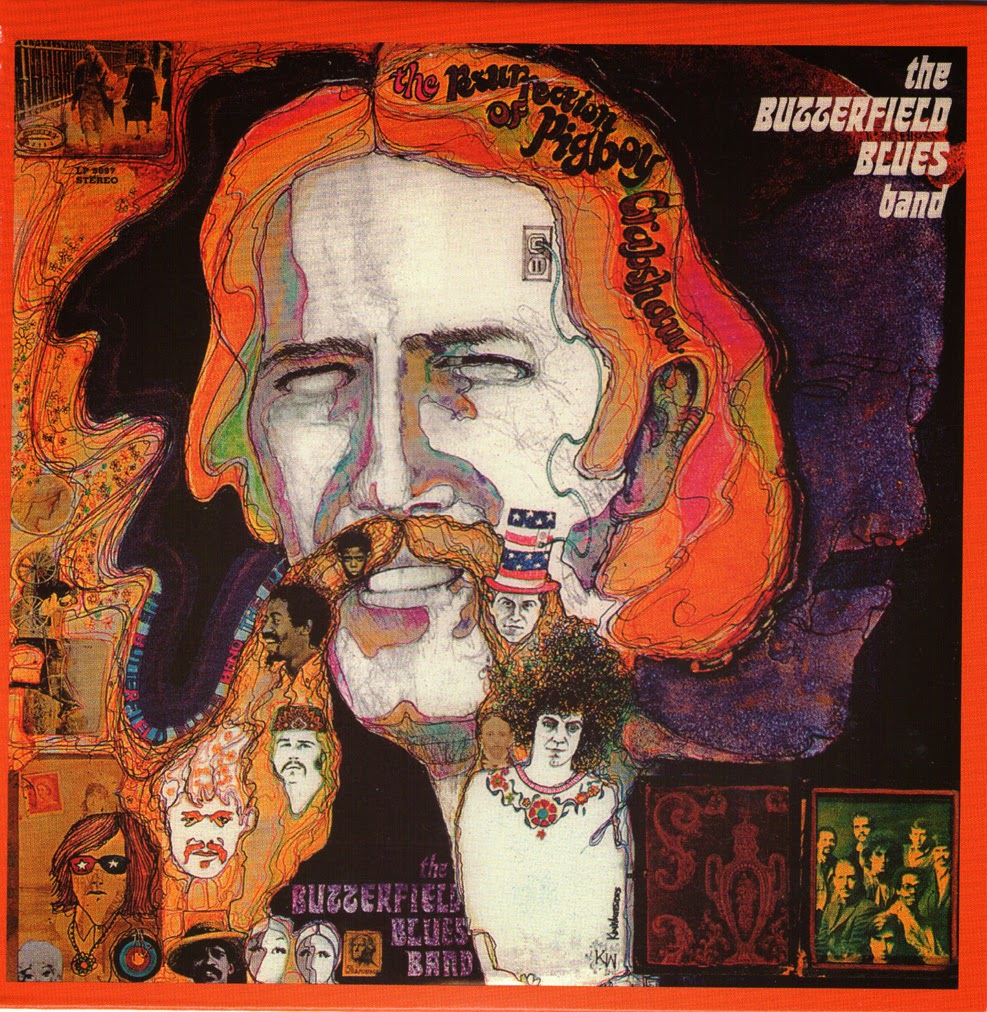
The Paul Butterfield Blues Band - The Resurrection Of The Pigboy Crabshaw (1967 us, sensational blues rock with jazzy mood)


The 1968 edition of the Paul Butterfield Blues Band featured a larger ensemble with a horn section, allowing for a jazzier feeling while retaining its Chicago blues core. They also adopted the psychedelic flower power stance of the era, as evidenced by a few selections, the rather oblique title, and the stunning pastiche art work on the cover. 

Butterfield himself was really coming into his own playing harmonica and singing, while his band of keyboardist Mark Naftalin, guitarist Elvin Bishop, drummer Phil Wilson, electric bassist Bugsy Maugh, and the horns featuring young alto saxophonist David Sanborn was as cohesive a unit as you'd find in this time period. Butterfield's most well known song "One More Heartache" kicks off the album, a definitive blues-rock radio favorite with great harmonica and an infectious beat urged on by the top-notch horns. 

The band covers "Born Under a Bad Sign" at a time when Cream  also did it -- which one was better? "Driftin' & Driftin'" is another well known tune, and over nine minutes is stretched out with the horns cryin' and sighin', including a definitive solo from Sanborn  over the choruses. There's the Otis Rush tune "Double Trouble," and "Drivin' Wheel" penned by Roosevelt Sykes; Butterfield wrote two tunes, including "Run Out of Time" and the somewhat psychedelic "Tollin' Bells" where Bishop's guitar and Naftalin's slow ringing, resonant keyboard evokes a haunting sound.

 Likely this is the single best Butterfield album of this time period, and though compilations or "best-of" discs are available (Golden Butter being the best), you'd be well served to pick this one first and go from there. 
by Michael G. Nastos


Tracks
1. One More Heartache (Smokey Robinson, The Miracles) – 3:20
2. Driftin' And Driftin' (Charles Brown, Johnny Moore, Eddie Williams) – 9:09
3. I Pity The Fool (Deadric Malone) – 6:00
4. Born Under A Bad Sign (William Bell, Booker T. Jones) – 4:10
5. Run Out Of Time (Paul Butterfield, Brother Gene Dinwiddie, Peterson) – 2:59
6. Double Trouble (Otis Rush) – 5:38
7. Drivin' Wheel (Roosevelt Sykes) – 5:34
8. Droppin' Out (Paul Butterfield, Tucker Zimmerman) – 2:16
9. Tollin' Bells (Traditional, Arr. Butterfield Blues Band) – 5:23

The Paul Butterfield Blues Band
*Paul Butterfield  - Harmonica, Vocals
*Elvin Bishop - Guitar, Vocals
*David Sanborn - Alto Saxophone
*Brother Gene Dinwiddie - Tenor Saxophone
*Bugsy Maugh - Bass, Vocals
*Mark Naftalin - Keyboards
*Phillip Wilson - Drums
*Keith Johnson - Trumpet

Paul Butterfield's back pages
1966-68  Strawberry Jam
1968  In My Own Dream
1969  Keep On Moving
1970  Live 
1971  Sometimes I Just Feel Like Smilin'
1973  Paul Butterfield's Better Days
1973  It All Comes Back (Japan Edition)
1976  Put It In Your Ear
Related Act
1969-70/72  Elvin Bishop - Party Till The Cows Come Home
1974  Elvin Bishop - Let It Flow
1977  Elvin Bishop - Live! Raisin' Hell

Free Text

  • Digg
  • Del.icio.us
  • StumbleUpon
  • Reddit
  • RSS

Euphoria - Euphoria (1969 us, bright ethereal sunny folk, korean remaster)


Anyone who has ever seen Tom Pacheco perform knows that they have been in the presence of greatness, watching a singer/songwriter who is a master of his craft and who, if there were any justice in the world (even though we know such a commodity is in desperately short supply in the 21st Century), would be as well-known as Woody Guthrie or Bob Dylan.

Tom has lived the life of a troubadour since the mid-1960s, and has now made around 20 original albums which have been released on a variety of labels in the USA (his earliest recordings and several more recently) and Europe (mainly in the last 20 ears). Yet Tom is not - yet - a household name, and one cannot avoid thinking that there are parallels between this often brilliant and always engaging artist and another artist in a different field, the celebrated painter Vincent Van Gogh. 

The latter is now recognised s a genius, yet in his lifetime, he famously failed to sell a single painting. Tom's fate has not been quite so desperate. He has managed to sell small quantities of is amazing albums over the past 35 years, but never as many as his artistry deserved. 

Tom was born on 4th November 1946, in New Bedford, Massachusetts. His father, Tony Pacheco, was a jazz guitarist who played with Django Reinhardt as well as solo in clubs in Europe before returning to the US to raise a family and open a music store, where he also taught guitar.

Tom began playing guitar at the age of 10, studying both Flamenco and classical styles, and in 1965, as a 9 year old, released his first solo album, “Turn Away rom The Storm”, a collection of original folk songs he had written two or three years before. It was made for a small local label known as Witchgreen Records, and Tom thinks they probably only pressed 500 copies. He also notes that he now owns that album and could be leased to license it if anyone's interested. The Van Gogh comparisons continue: that solo album could soon be reissued, and now the Euphoria album.

Tom left Massachusetts to study at Hofstra niversity in New York City, where he formed a band called The Ragamuffins, which supported Jimi Hendrix in a number of occasions and also released two singles on Seville and London Records. These singles are extremely obscure; no doubt, if Tom had become a superstar, they would have been reissued on many occasions, but as it is, hunting through oldies shops probably provides the only solution if anyone feels that owning them is important. 

In 1969 Tom joined forces with The Beckets which actually were Roger and Wendy Penney, they started their entertainment careers as actors, working with Boston's Theatre Company.  Using the stage name Roger and Wendy Beckett, by the mid-'60s the pair had turned their attentions to music, becoming fixtures on New York's Greenwich Village folk club scene.  By the time they released their 1967 debut collection, they'd followed the crowd into a more electrified folk-rock sound with Roger jammin' on electric autoharp, while Wendy had picked up electric bass. After splitting Euphoria the couple toured and released  records as Roger and Wendy and later -in mid seventies- as The Bermuda Triangle.

Back to Euphoria,  Tom recalls: 'Thirty years later, I listened to Eurphoria album and realized it was not as bad as I thought it was, considering the times. If it weren't for that album at that point in my life I might have quit playing music professionally and become an English teacher, something I had gone to University to study". 

Which explains why Tom's lyrics are so impressive. He could have been a great teacher... The sleeve picture of Euphoria is curious, to say the least. A very tall female standing with a male dwarf. Tom explained: "That was a picture of a relative of mine, who was dreadfully poor, but very attractive, and she married a rich dwarf who lived on an island in The Azores, and lived happily ever after with him. The female head has half of Sharon's face and half of Wendy Becket's and the dwarf has half Roger's face and half mine". 

Tom now has a band in Norway with whom he recorded 'The Long Walk', released by Playground Music Scandinavia, which is an album full of his songs, while Jim Welder produced and performed instrumental tracks on 

Tom's newest album, 'Year Of The Big Wind (Bare Bones III)', recorded at Moonhaw Studios in Woodstock and released by Frog's Claw Recordings.
by John Tobler, Washington, 2004


Tracks
1. There Is Now (Tom Pacheco) - 4:17
2. What a Day (Tom Pacheco) - 2:09
3. Seldom Seen Slim (Tom Pacheco) - 4:27
4. Sun and Shadow (Tom Pacheco) - 2:19
5. Sitting In a Rocking Chair  (Rowland Barter) - 3:35
6. Ride the Magic Carpet (Barkan, Dams) - 2:51
7. You Must Forget (Tom Pacheco) - 3:36
8. Tucson (Tom Pacheco) - 3:02
9. Calm Down (Tom Pacheco) - 2:23
10.Sleep (Tom Pacheco) - 2:25
11.Walkin' Through the City (Tom Pacheco) - 1:59

Euphoria
*Sharon Alexander - Percussion
*Tom Pacheco - Guitar
*Roger Penney (Roger Becket) - Vocals, Electric Autoharp, Keyboards
*Wendy Penney (Wendy Becket) - Vocals, Bass

Related Act
1977  Bermuda Triangle

Free Text

  • Digg
  • Del.icio.us
  • StumbleUpon
  • Reddit
  • RSS